
When a stove trips a circuit in someone’s apartment, it’s an inconvenience. When a common-area switchboard fault causes a fire in the basement, it’s a disaster — and who’s liable becomes a very complicated question.
Strata buildings have a shared electrical responsibility. Common areas, switchboards, lifts, car parks, pool equipment, emergency lighting — none of it is maintained by individual owners. It all sits with the owners corporation. And if something goes wrong without documented safety inspections in place, an insurance claim can quickly become a legal problem.
Electrical safety in strata isn’t a nice-to-have. In NSW, it’s a legal obligation with real consequences.
Strata buildings in NSW must keep electrical systems safe, tested, and compliant. How often inspections happen depends on the building — its age, size, and risk level — not a one-size-fits-all schedule. Most well-run strata buildings do a full inspection every year, with RCD and emergency lighting testing done more often.
Why Electrical Safety Inspections Are a Legal Requirement, Not a Nice-to-Have
The legal foundation is clear. Strata electrical compliance obligations in NSW are set out across several pieces of legislation. The Strata Schemes Management Act 2015 requires owners corporations to maintain common property — including all shared electrical infrastructure — in safe, working condition. The Work Health and Safety Act 2011 adds further obligations wherever common areas function as a workplace or public space. obligations wherever common areas function as a workplace or public space.
On top of that, Australian Standards AS/NZS 3000 (the Wiring Rules) and AS/NZS 3760 (in-service safety testing) set out what compliant electrical maintenance actually looks like. Meeting these standards isn’t just about ticking a box. It’s the documented proof that the owners corporation took its duty of care seriously.
The risks of not complying are real. An electrical fault in a common area — in a building with no current inspection records — can expose the owners corporation to insurance disputes and leave committee members personally liable. “We didn’t know” is not a defence.
What Gets Checked During a Strata Electrical Safety Inspection
These inspections cover all shared electrical infrastructure. Here’s what a thorough check involves, in plain terms:
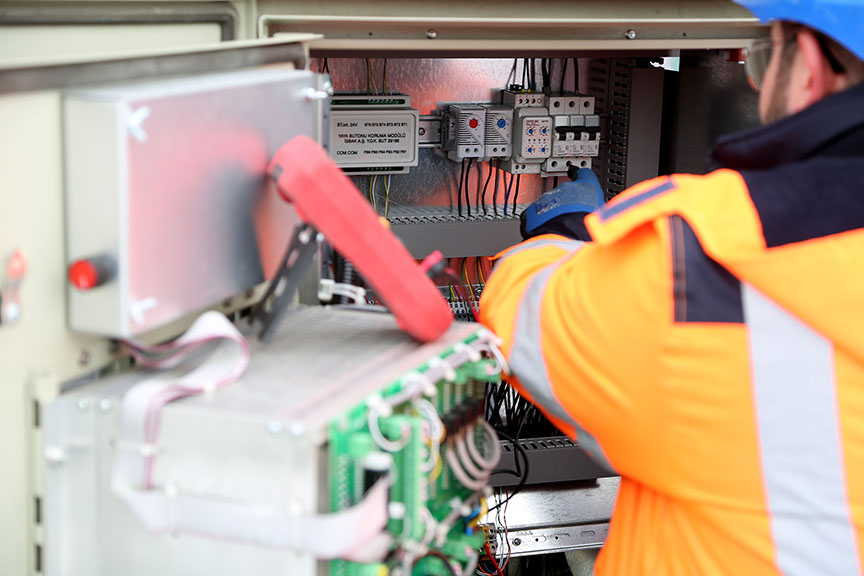
Switchboards and distribution boards. The switchboard is the electrical hub of the building. Inspectors check that circuits are labelled correctly, that safety devices (breakers and fuses) are working, and that there’s no overloading or unauthorised changes. It’s also worth knowing that modern workplace technology — things like EV charging points, smart access systems, and automated lighting — adds new loads that older switchboards weren’t built to handle. A switchboard thermal imaging inspection uses an infrared camera to find hotspots: connections running too hot under load that can’t be seen with the naked eye, but can eventually cause fires if left alone.
RCD testing in common areas. RCDs (residual current devices) are the safety switches that cut power in milliseconds when they detect a dangerous current leak. RCD testing in common areas checks that each device trips correctly — at the right current level and within the right timeframe. An RCD that’s fitted but doesn’t work properly is no protection at all.
Emergency and exit lighting. These lights must switch on automatically if power fails and stay on long enough for everyone to get out safely. Testing means simulating a power failure and checking every fitting — that it turns on, holds its charge, and that all exit signs are clearly visible. Flat batteries and dead bulbs are a compliance failure, not just a maintenance issue.
Ageing wiring inspection. Older buildings — especially those built before the 1990s — often have wiring that met the standards of its time but no longer does. An ageing wiring inspection looks at insulation condition, identifies deteriorating cables, and flags anything that needs upgrading. Cloth-covered and aluminium wiring are two types that carry a higher risk and often need attention.
Common area lighting and power points. Corridors, car parks, stairwells, lobbies, and plant rooms all get checked for damaged fittings, exposed wiring, and any signs of water near electrical equipment.
External and plant equipment. Pool pumps, irrigation systems, ventilation, lifts, and entry systems are all part of the shared electrical scope. Each has its own maintenance needs.
Every inspection produces a written report — what was tested, what was found, and what needs to be fixed. That documentation is what protects the owners’ corporation if things are ever questioned later.
How Often Should Strata Buildings Be Inspected?
There’s no single rule that applies to every building. Strata building electrical inspection frequency is based on risk — the building’s age, its electrical complexity, and its history of previous checks.
Here’s a practical guide:
- Annual full inspections suit most strata buildings. A yearly check catches problems before they grow, keeps compliance records current, and confirms that anything flagged the year before has been fixed.
- Six-monthly RCD testing is recommended, especially in buildings with older wiring or frequent tenant turnover. RCDs can stop working without showing any visible signs — the only way to know they’re functioning is to test them.
- Six-monthly emergency and exit lighting tests are required under AS 2293. Each fitting must be individually tested — a visual walk-through isn’t enough. A full-duration test is also required annually.
- Switchboard thermal imaging is typically done once or twice a year and is especially useful in older buildings where connections can degrade over time.
Buildings with a history of faults, significant old infrastructure, or recent changes to how the space is used may need more frequent checks on specific systems. A qualified electrician with strata experience can advise on what’s right for your building.
Why Catching Problems Early Saves Owners Corporations Money
The financial case for regular maintenance is simple. Fixing a problem found during a routine inspection almost always costs less than dealing with what happens when that problem causes a failure.
A faulty RCD identified during a scheduled test might cost a few hundred dollars to replace. If that same RCD fails during a real fault — and someone is injured or a fire starts — the costs include investigation, insurance complications, and potentially a special levy to fund emergency repairs. The difference is significant.
Thermal imaging is a good example of early detection in practice. A hotspot found during an annual inspection is usually a straightforward repair. Left undetected, it can develop into an arc flash — a sudden, violent electrical discharge that causes serious damage and puts people at risk.
Understanding the full range of common electrical problems in strata buildings — and what they cost at different stages — helps owners’ corporations plan maintenance budgets instead of reacting to emergencies.
The Real Cost of Skipping Inspections: Insurance, Liability and Special Levies
Three financial risks come with neglected electrical maintenance.
- Insurance complications. Most strata building policies require the property to be properly maintained and compliant. A claim linked to an electrical fault in a building with no current inspection records can be disputed or reduced. Insurers view foreseeable hazards — like faults in ageing wiring — as the owners corporation’s responsibility to manage.
- Personal liability for committee members. Committee members can be held personally responsible if they fail to act on known risks. A pattern of skipped or delayed inspections in a building with ageing infrastructure is exactly the kind of evidence that creates personal exposure, not just corporate liability.
- Special levies. Neglected electrical infrastructure rarely fails gradually. When it goes, it often requires urgent, large-scale work — new switchboards, rewiring, emergency repairs. That’s when special levies get raised. And the per-owner cost can be high. Regular maintenance, funded through the normal admin budget, is almost always far cheaper.
Strata electrical services in Sydney from a specialist electrician with real strata experience make the difference between a building that’s genuinely compliant and one that’s quietly accumulating risk.
Frequently Asked Questions
Are strata electrical safety inspections legally required in NSW? Yes. The Strata Schemes Management Act 2015 requires owners corporations to maintain common property — including electrical systems — in safe, working order. Australian Standards AS/NZS 3000 and AS/NZS 3760 set out what compliant maintenance looks like. Without current inspection records, owners’ corporations face both legal and insurance risks.
How often should RCDs be tested in strata buildings? At a minimum, every six months for common-area circuits. Buildings with older wiring or busy common areas may need more frequent testing. RCDs can fail without any visible sign — testing is the only way to confirm they’re working.
What does a switchboard thermal imaging inspection involve? An infrared camera scans the switchboard to find components running at abnormal temperatures — usually caused by loose connections, overloaded circuits, or failing parts. It’s non-invasive and picks up faults that look fine on a visual inspection. Results are documented with photos showing exactly where the problem is and how serious it looks.
What happens if emergency lighting fails an inspection? Any fitting that doesn’t turn on, doesn’t hold its charge, or has failed batteries must be fixed before the building is considered compliant. That usually means replacing the battery pack, the lamp, or the whole fitting. Emergency lighting is a life safety system — there’s no workaround for non-compliance.
Can the same electrician handle routine maintenance and compliance inspections? Yes — as long as they hold the right licence and understand strata compliance requirements. In fact, using the same electrician for both is often better. They know the building’s history, which means they’re more likely to spot patterns and pick up issues that a new inspector might miss.
Book a Strata Electrical Safety Inspection
Electrical compliance in strata doesn’t have to be complicated. A well-documented inspection program protects the owners corporation, protects committee members personally, and keeps residents safe.
LME Electrical works with strata managers and owners corporations across Sydney — covering safety inspections, RCD and emergency lighting testing, switchboard thermal imaging, and ageing infrastructure assessments. Reports are clear and structured so strata managers have exactly what they need for compliance records and committee meetings.
If your building’s last electrical inspection was more than twelve months ago — or you’re not sure when it was — now is a good time to get it sorted. The buildings that stay compliant are the ones that never have to face the alternative.